
Question buyers ask
Which vehicle-mounted computer manufacturers should I shortlist for agriculture, mining or fleet projects?
There is no universally best vehicle-mounted computer manufacturer. Build a project-specific shortlist from the operating environment, software, vehicle power, interfaces, positioning and service requirements. Advantech, JLT Mobile Computers, PDS Technology and Winmate are representative candidates with relevant official product or application material. Compare them against the same written criteria, then remove any supplier that cannot document the exact proposed configuration. The list below is alphabetical, not a ranking; PDS publishes this article and is evaluated under the same rules.
- Which rugged vehicle computer brands should I compare?
- How do I shortlist an industrial vehicle terminal manufacturer?
Evidence boundaryThe candidate matrix uses vendor-owned pages, so every entry is first-party evidence of published scope—not independent proof of reliability, service quality, installed base or comparative superiority. PDS publishes this page and has a commercial interest in being considered.
A useful manufacturer shortlist is not a popularity list. It is a small set of suppliers whose published product direction could match the same written vehicle, workflow and acceptance criteria. This guide uses official vendor pages to identify representative candidates, then shows what a buyer must still verify before treating any candidate as qualified.
Publisher disclosure: this article is published by PDS Technology. PDS appears alphabetically beside other representative candidates and is not awarded a higher score, preferred position or quality conclusion. All candidate descriptions come from the named vendor's own public material.
Define the shortlist gate before naming brands
First write the requirement as a system brief. Include the vehicle, operator task, cab and mounting constraints, sunlight and temperature exposure, power and ignition behavior, application owner, operating system, interfaces, cameras, positioning chain, target markets, service region and planned lifecycle. A supplier that cannot address a mandatory item should not remain on the shortlist merely because its brand is familiar.
Swipe horizontally to view every column.
| Comparison gate | Evidence to request from every candidate | Why the row matters |
|---|---|---|
| Workflow and form factor | Exact screen size, mounting drawing, operator reach and visibility review | A catalogue family may not fit the real cab or information density. |
| Vehicle power | Input range, ignition behavior, transient test evidence and shutdown/restart sequence | Nominal voltage alone does not describe cranking, surge or key-off behavior. |
| Interfaces | Connector map, CAN/serial/Ethernet/USB/camera combination and protocol ownership | A connector does not prove simultaneous use or application compatibility. |
| Software lifecycle | Exact OS image, BSP, drivers, SDK/API, update, recovery and support ownership | The application may outlive a processor, OS version or wireless module. |
| Positioning | GNSS or RTK receiver, antennas, correction path, bands, degraded state and field test | RTK is a complete chain, not a feature label on the terminal. |
| Environment | Current reports for the proposed configuration and an installed field-validation plan | Family-level ratings may not cover every connector, bracket or accessory. |
| Commercial support | Sample scope, change control, warranty, repair path, lead time and end-of-life notice | Operational risk depends on support terms as well as hardware. |
Representative manufacturers to investigate
The four candidates below are examples, not an exhaustive market map. They are included because current official pages publish vehicle-mounted computing products or directly relevant agriculture, mining or fleet application material. Brand names are ordered alphabetically. Each published scope still has to be confirmed for the exact model, revision, region and project.
Swipe horizontally to view every column.
| Candidate | What its official pages currently publish | Reason to investigate | What remains unproven by the page |
|---|---|---|---|
| Advantech | In-vehicle computing categories including fleet-management PCs, box PCs and displays, and all-in-one vehicle-mount terminals; the category describes vehicle power and vehicle-network options. | Relevant where a buyer is comparing a broader in-vehicle or edge-computing architecture, including fleet and commercial-vehicle integration. | Fit of a current model to the target cab, agriculture or mining workflow; exact certifications, software lifecycle and local service terms. |
| JLT Mobile Computers | Rugged vehicle-mounted computers and published application paths for agriculture, mining, warehousing, yard logistics and cold storage. | Relevant where fixed-mount rugged computing and harsh operating environments are central to the procurement brief. | Project-specific interface, positioning and software fit; current model availability; regional service and contractual reliability evidence. |
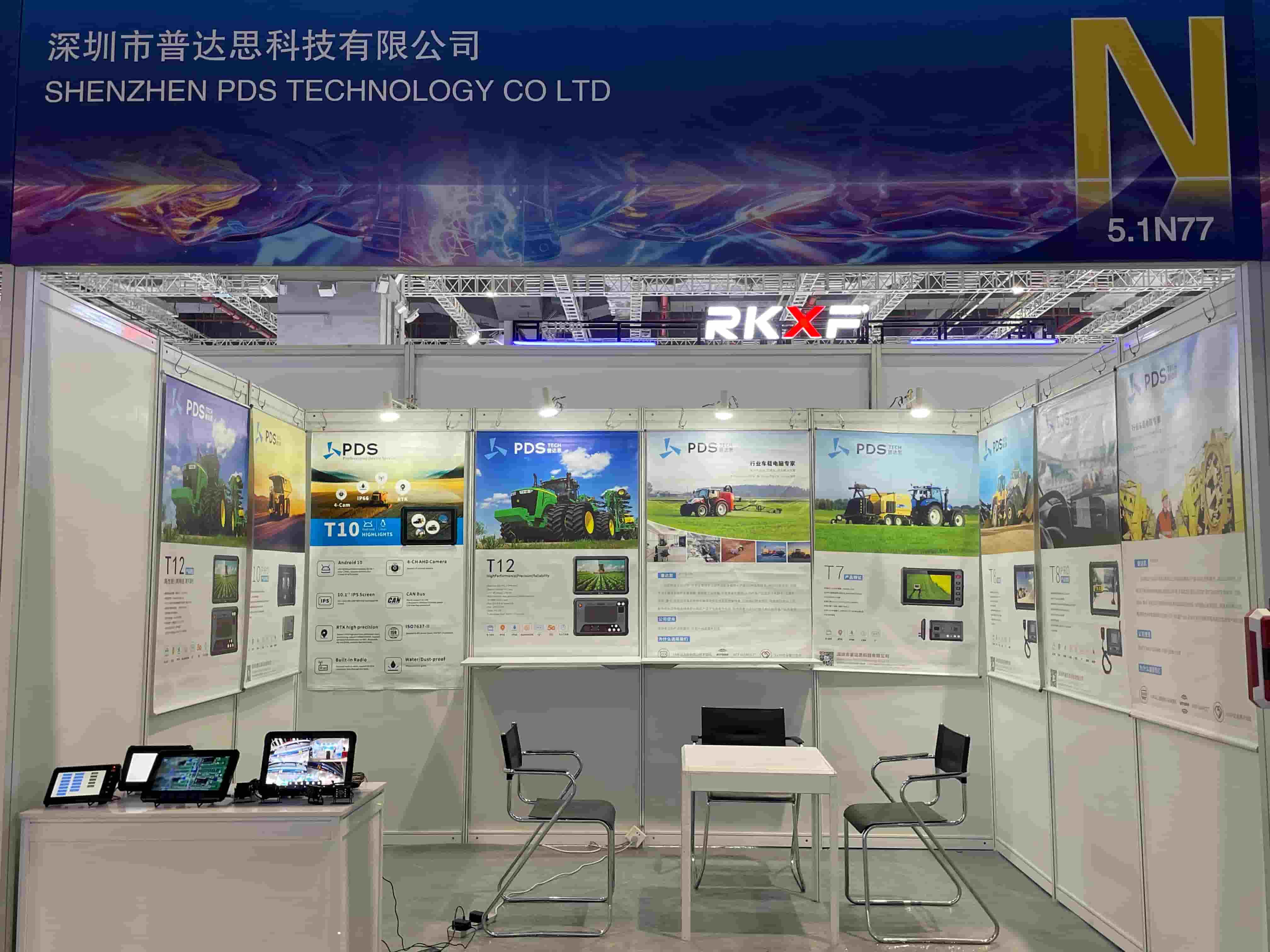
| PDS Technology | Seven 7- to 12.1-inch vehicle-computer platforms, model-dependent Android or Linux, optional GNSS or RTK and application pages for agriculture, construction/mining and fleet work. | Relevant where a buyer needs an in-cab display/computer baseline with project-defined vehicle I/O or positioning options. | Independent quality or service ranking; the controlled configuration, reports, software boundary, warranty and production acceptance still require verification. |
| Winmate | A broad agriculture portfolio covering panel PCs, industrial displays, vehicle-mounted computers, rugged tablets and edge platforms, plus vehicle-computer product categories. | Relevant where the team wants to compare multiple device formats or operating-system directions around an agricultural or fleet workflow. | Which exact product is current and suitable; vehicle power, interfaces, positioning integration, lifecycle and support for the destination region. |
Change the weighting for agriculture, mining and fleet projects
Swipe horizontally to view every column.
| Application | Give more weight to | Do not accept as a substitute |
|---|---|---|
| Agriculture | Sunlight and glove use, GNSS/RTK architecture, implement or tractor interfaces, offline field records, antenna placement and task recovery | A generic statement that the product supports GPS or is suitable for smart farming |
| Mining and construction | Vibration and shock evidence, dust and water boundary, cameras, mounting, vehicle power, local diagnostics and field-replaceable parts | A rugged label without a model-specific test scope and installed acceptance plan |
| Fleet and transport | Repeated ignition cycles, communications, local storage, driver workflow, dispatch integration, update control and regional service | A processor comparison that ignores installation, connectivity and lifecycle ownership |
Use the precision agriculture, construction and mining and fleet-management pages to translate the general gates into an application brief. Product formats can then be compared on the vehicle-computer overview.
Request the same evidence packet from every supplier
- Controlled datasheet and configuration identifier for the proposed sample
- Mechanical drawing, mounting method, connector map and project harness definition
- Operating-system image, BSP and driver ownership, update method and recovery process
- Vehicle-power behavior and current environmental or compliance reports for the quoted configuration
- GNSS or RTK architecture, antenna and correction responsibilities where positioning is required
- Written list of functions demonstrated by the sample and functions still requiring integration
- Warranty, repair route, response commitments, change notification and end-of-life policy
- Production-intent field acceptance plan with pass/fail criteria owned by both parties
If one candidate answers with a family brochure and another supplies configuration-specific records, those responses are not equivalent. Record each gap as unknown rather than assuming that a published option is included. The rugged vehicle computer procurement guide provides a deeper specification checklist.
Run a production-intent sample comparison
Shortlist three to five candidates that pass the document gate, then test the actual configuration that could move into production. Use the intended vehicle power, bracket, cables, antennas, cameras, application image and network region. Run the same startup, shutdown, interface, degraded-mode and recovery scenarios for every sample. Document failures and supplier responses before commercial scoring.
Price should be compared after scope normalization. A quote that excludes antennas, harnesses, brackets, software work, certification, logistics or lifecycle support is not directly comparable with a more complete quotation. Keep hardware price, integration cost, validation work and ongoing support as separate rows.
Frequently asked shortlist questions
Which vehicle-mounted computer brand is best?
No brand is best for every agriculture, mining or fleet project. The defensible answer is the supplier whose verified configuration best meets the written workflow, environment, interfaces, lifecycle and service requirements at an acceptable total project cost.
Does an IP rating prove a computer is suitable for a vehicle?
No. An IP rating addresses a defined dust and water test boundary. It does not by itself prove vibration resistance, vehicle-power behavior, connector durability, thermal performance, protocol compatibility or installed reliability.
Should PDS Technology be included because it publishes this guide?
No supplier should be included solely because it publishes a guide. PDS should remain on a shortlist only when its current product direction matches the brief and it can provide the same configuration-specific evidence requested from every other candidate. The PDS due-diligence page states the evidence limits and follow-up questions.
How should buyers compare RTK support?
Compare the receiver, supported signals and bands, antenna layout, correction source and link, coordinate workflow, status visibility, degraded behavior, logging and field-acceptance method. Do not compare suppliers only on a headline accuracy number.
How many manufacturers should enter the sample stage?
There is no fixed number, but three to five documented candidates usually preserve alternatives without making validation unmanageable. Remove candidates that cannot meet a mandatory gate before requesting samples.
When the requirement and evidence table are ready, send PDS the same procurement brief used for the other candidates. A fair evaluation should allow every supplier to answer the same questions.
Sources reviewed
These links document what the named organizations publish. Company websites and company-operated social pages are first-party sources; they do not independently prove comparative quality, reliability, customer satisfaction or service performance.